



Choosing the right insulation for a commercial building is one of the most important decisions a contractor or building owner will make. The wrong choice leads to higher energy bills, comfort problems, and code violations.
This guide covers the main types of insulation used in commercial buildings, explains why reflective insulation is gaining ground in heat-intensive environments, and helps you match the right product to your specific project.
What Type of Insulation Is Used in Commercial Buildings
Commercial buildings use several types of insulation depending on the location in the structure, the climate, and the building's purpose. The most common options are fiberglass, mineral wool, spray foam, rigid foam, and reflective insulation.
Each material handles heat differently. Most traditional insulation types resist conductive heat, which moves through solid materials. However, many large commercial structures, especially those with metal roofs and walls, face a bigger challenge from radiant heat. This is heat that travels through the air as energy and gets absorbed by surfaces.
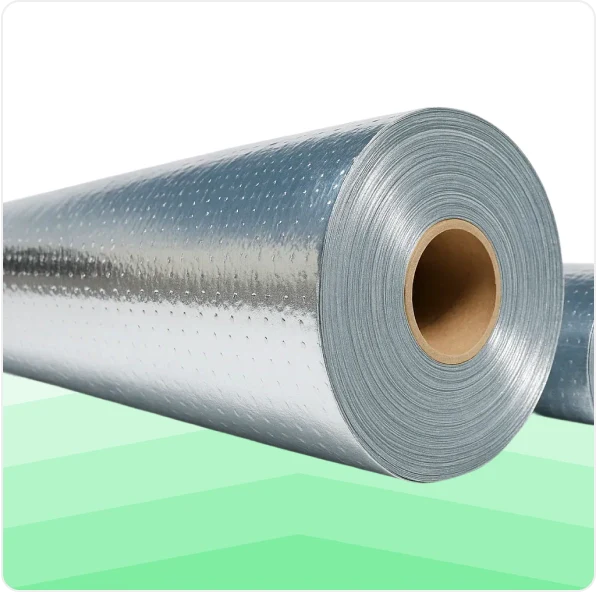
Reflective insulation addresses this problem directly, making it a standout choice for warehouses, factories, and large commercial structures where standard insulation alone is not enough.
Common Insulation Types Used in Commercial Buildings
Fiberglass Insulation
Fiberglass is widely used due to its low cost and availability in batts, rolls, and loose-fill. However, its performance can drop when compressed or exposed to moisture, and it typically requires additional air barriers to reach rated R-values.
Mineral Wool Insulation
Mineral wool offers strong fire resistance and sound control. It is commonly used in fire-rated assemblies and commercial partitions but comes at a higher material cost.
Spray Foam and Rigid Board Insulation
Spray foam provides high R-value per inch and excellent air sealing, while rigid boards like polyiso are commonly used in roofing systems. Both offer strong thermal performance but increase project cost and installation complexity.
Reflective Insulation
Fiberglass, foam, and rigid board address conductive heat. What they cannot address is radiant heat, the solar energy that metal roofs and exterior walls absorb throughout the day and radiate into the building interior. Standard R-value ratings do not measure this, which is why a building with R-19 fiberglass can still overheat on a sunny day.
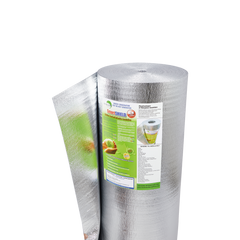
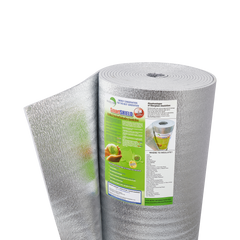
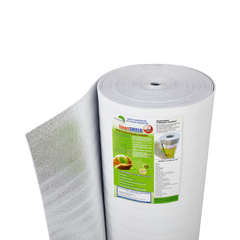
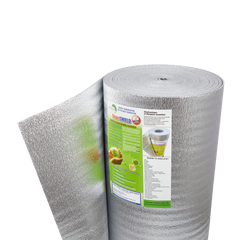
SmartSHIELD and SmartFOIL reflective insulation block up to 97% of radiant heat. For warehouses, distribution centers, and any large commercial structure with significant roof exposure, reflective insulation addresses the heat source that other insulation types miss entirely.
See the full range of metal building insulation options to find the right fit for your project.
Why Reflective Insulation Stands Out for Commercial Buildings
Radiant Heat vs Conductive Heat
Most commercial buildings, especially warehouses, distribution centers, and manufacturing facilities, have large metal roof areas. Metal absorbs solar radiation quickly and radiates that heat into the interior space below. This is radiant heat transfer, and it is a problem that traditional fiberglass or foam insulation cannot fully address on its own.
A building insulated with R-19 fiberglass may still overheat on sunny days because the insulation does not reflect radiant energy. It only slows conductive heat flow. Reflective insulation placed on the underside of a roof deck or inside a wall assembly stops radiant heat before it enters the occupied space.
Performance Advantages for Commercial Applications
- Fire rated: Class A fire rating, required under commercial building codes across the United States
- Moisture resistant: Protects against condensation damage in humid climates
- Non-toxic: Safe to handle and install without respiratory protection
- Fast to install: Large roll format covers wide commercial surface areas quickly, reducing labor time and overall installation cost
Best Reflective Insulation for Commercial Buildings
SmartSHIELD Foam Core Reflective Insulation
SmartSHIELD foam core reflective insulation combines a closed-cell polyethylene foam core with double-sided 99 percent reflective foil. It delivers an R-value from R-15 up to R-29 depending on installation and air space configuration. This makes it one of the most versatile reflective products available for commercial use.
SmartSHIELD is well suited for walls, ceilings, ductwork, and metal building applications. The foam core adds a layer of conductive resistance on top of the radiant barrier properties, giving contractors a single product that addresses both heat transfer types. It is lightweight, flexible, and easy to cut and install across large commercial surface areas.

SmartFOIL Radiant Barrier
SmartFOIL radiant barrier is a pure aluminum radiant barrier designed for applications where maximum reflectivity is the priority. It carries Class 1 and Class A fire ratings under ASTM E-84, meeting all US commercial building code requirements.
SmartFOIL is the right choice for roof decks, open warehouse ceilings, and retrofit projects where adding insulation thickness is not practical. It reflects radiant heat before it reaches the structure below and can be installed quickly across large spans with minimal seams. For existing buildings looking to reduce cooling costs without major structural changes, SmartFOIL is one of the most cost-effective upgrades available.

What to Consider When Choosing Commercial Building Insulation
R-Value Requirements
R-value requirements for commercial buildings vary by climate zone and building component. The US Department of Energy and ASHRAE 90.1 set the commercial standards that most state and local codes are based on.
For commercial roofs, R-values commonly range from:
- R-20 in warmer southern climates
- R-30 to R-35 or higher in colder northern regions
Always verify the current IECC requirements for your specific climate zone before specifying materials.
Fire Rating and Code Compliance
Fire safety is a critical requirement in commercial construction.
Most jurisdictions require a Class A or Class 1 fire rating under ASTM E-84 for insulation used in commercial applications.
SmartSHIELD and SmartFOIL are tested to meet ASTM E-84 Class A / Class 1 standards, making them compliant choices for commercial applications without requiring additional fire treatments in many standard assemblies.
Moisture Control and Installation Speed
Moisture management plays a major role in long-term insulation performance, especially in humid or mixed climates.
Traditional insulation materials can absorb moisture, which may reduce thermal performance and contribute to mold or structural issues over time.
Reflective insulation offers inherent moisture resistance, making it a reliable option for environments exposed to humidity or condensation.
Get Commercial-Grade Insulation at Factory-Direct Prices
Insulation MarketPlace offers a full range of commercial-grade reflective insulation, including SmartSHIELD and SmartFOIL, designed for performance, compliance, and ease of installation.
Key benefits include:
- Factory-direct pricing for better cost control
- US-tested and certified products
- 10-year product warranty
- 60-day money-back guarantee
For contractors and large projects, bulk pricing and dedicated support are available through the Business Portal.
Shop direct at Insulation MarketPlace for factory pricing, free shipping, and a 10-year warranty on every order.
FAQs
What type of insulation is most commonly used in commercial buildings?
Fiberglass, mineral wool, spray foam, rigid foam boards, and reflective insulation are all widely used. The best choice depends on the location in the building and its purpose. For commercial structures with metal roofs and walls, reflective insulation is increasingly the preferred option because it addresses radiant heat that traditional materials cannot block.
What R-value is required for commercial building insulation?
The DOE recommends R-19 to R-60 for commercial roofs depending on the climate zone. Wall requirements also vary. Always check ASHRAE 90.1 and your local IECC adoption to confirm the minimum R-values for your specific project location and building type.
Is reflective insulation code-compliant for commercial buildings?
Yes. SmartSHIELD and SmartFOIL both carry Class 1 and Class A fire ratings under ASTM E-84, which meets the requirements of US commercial building codes across all states.
What is the best insulation for a metal commercial building?
SmartSHIELD foam core reflective insulation is the best choice for walls and ceilings in metal buildings. SmartFOIL radiant barrier is ideal for roof decks and open ceiling applications. Using both together provides comprehensive protection against both conductive and radiant heat.
Can contractors buy insulation in bulk from Insulation MarketPlace?
Yes. The Business Portal at Insulation MarketPlace offers bulk pricing and dedicated support for contractors managing large or multiple projects. Contact the team directly to set up a business account and access contractor pricing.